Security Architecture Reviews for Small Businesses: Securing Your Data Effectively

In today’s digital landscape, businesses of all sizes must prioritize data security to protect sensitive information and maintain customer trust. For small businesses, securing data can be particularly challenging due to limited resources and expertise. One effective solution is conducting security architecture reviews, which can help identify vulnerabilities and ensure that your business is following best practices. Let’s explore what security architecture reviews can entail and how they can benefit small businesses looking to safeguard their data.

Understanding Security Architecture Reviews

A security architecture review is a systematic evaluation of an organization’s IT infrastructure, policies, and procedures from a security perspective. It aims to identify potential vulnerabilities, assess the effectiveness of current security controls, and ensure compliance with industry standards and regulations. The review process typically involves the following steps:

  1. Scope definition: Determine the key components of your IT infrastructure that need to be assessed. This may include networks, servers, applications, databases, and cloud environments.
  2. Data collection: Gather relevant documentation, such as network diagrams, system configurations, security policies, and access control lists. This information will be used to understand your current security posture.
  3. Analysis and assessment: Analyze the collected data to identify potential vulnerabilities, gaps in security controls, and non-compliance with industry standards. Security experts may use automated tools, manual techniques, or a combination of both to perform this analysis.
  4. Recommendations and remediation: Develop a prioritized list of recommendations to address the identified vulnerabilities and improve your overall security posture. This may include implementing new security controls, updating policies and procedures, or investing in employee training.
  5. Reporting: Prepare a comprehensive report detailing the findings, recommendations, and any remediation actions taken. This report serves as a valuable resource for ongoing security management and continuous improvement.

How Security Architecture Reviews Benefit Small Businesses

Small businesses can reap significant benefits from conducting security architecture reviews, including:

  1. Identifying vulnerabilities: The review process helps identify potential security weaknesses in your IT infrastructure that could be exploited by cybercriminals. By addressing these vulnerabilities, you can better protect your sensitive data and reduce the risk of security breaches.
  2. Ensuring compliance: Security architecture reviews help ensure that your business is complying with industry standards and regulations, such as the General Data Protection Regulation (GDPR) or the Health Insurance Portability and Accountability Act (HIPAA). Non-compliance can result in hefty fines and reputational damage, so it’s essential to stay up-to-date with these requirements.
  3. Enhancing customer trust: Demonstrating a commitment to data security can help build trust with your customers, as they will be more confident that their personal information is being protected. This trust is especially important for small businesses that may rely heavily on customer loyalty and referrals.
  4. Improving operational efficiency: A well-designed security architecture can enhance your organization’s operational efficiency by reducing the risk of downtime caused by security incidents, streamlining access control processes, and optimizing system performance.
  5. Facilitating informed decision-making: The insights gained from a security architecture review can help you make informed decisions about where to invest your limited resources for maximum impact on your security posture.

As a small business owner, it’s crucial to prioritize data security to protect your valuable assets, maintain customer trust, and ensure compliance with industry standards. Conducting a security architecture review is an effective way to assess your current security posture, identify potential vulnerabilities, and implement targeted improvements.

Don’t leave your business’s security to chance – invest in a security architecture review to safeguard your data and enhance your organization’s resilience against cyber threats. Contact our team of security experts today to learn more about how we can help!

Managing Identity in the Cloud

Identity and Access Management (IAM) is the foundation of AWS security; it is used to manage access to all AWS resources. In an AWS environment, IAM policies are used to grant or deny permissions to AWS resources. AWS provides a set of default policies that can be used to manage access to resources, but organizations often create custom policies to meet their specific security requirements.

Auditing IAM policies involves reviewing the permissions granted to users, groups, and roles in an AWS environment, and verifying that these permissions are consistent with company policies and regulations. Auditing IAM policies also involves reviewing user access logs, which can help organizations detect unauthorized access attempts or suspicious activity.

For instance, AWS IAM provides detailed logs through AWS Cloudtrail that allow companies to monitor user activity and detect suspicious behavior. Additionally, AWS provides a range of security services, such as Amazon GuardDuty and AWS Security Hub, that can help companies detect potential security threats and take action to address them.

By leveraging these AWS services and features, companies can identify and address potential security risks in their IAM policies before they lead to a security incident. Regular access reviews can help companies maintain compliance with regulations such as HIPAA, PCI, and GDPR, and demonstrate a commitment to security best practices.

Overall, IAM auditing is an essential component of cloud security in AWS environments. By taking advantage of the features and services offered by AWS, companies can achieve regular access reviews, prevent security incidents, and protect their sensitive data and assets.

—–

By leveraging AWS services such as IAM, Amazon GuardDuty, and AWS Security Hub, companies can detect potential security risks in their IAM policies and take action to address them. However, managing IAM policies and access control can be complex and time-consuming, especially for large organizations with multiple teams and cloud accounts. This is where Druid Security can help.

Druid Security is a leading cloud security company that specializes in helping companies secure their cloud environments, including AWS. Our team of experienced security experts can help you perform comprehensive IAM audits, identify potential security risks, and provide recommendations to improve your cloud security posture. By partnering with Druid Security, you can rest assured that your cloud environment is secure and compliant with industry regulations.

To learn more about how Druid Security can help you secure your AWS environment, contact us today. Our team of experts is ready to help you achieve cloud security excellence.

What is CyberSecurity Coaching?

Like any good skill set, cybersecurity needs constant attention and exercise. Today’s world demands businesses invest heavily in cybersecurity. Failure to do so will most likely result in major incidents such as hacking, phishing, or ransomware. Even so, many businesses simply cannot afford a host of experts and tooling to decrease their risk.

Enter Druid Security’s cybersecurity coach. Imagine your business is a football team. Just like a football team needs a coach to guide them through practices, strategize for games, and make adjustments on the field, Druid Security provides your business with a plan to navigate the complex world of online threats and vulnerabilities.

A cybersecurity business coach is like a personal trainer for your business’s cyber defenses. We will assess your current cybersecurity posture, identify areas for improvement, and provide tailored guidance on how to strengthen your defenses. We will work together to ensure that you address the most threats, in the most cost-effective manner possible.

A play by play

Similar to a Virtual CISO (VCISO), a cybersecurity coach is your advisor and cheerleader. A normal engagement with Druid Security starts with a deep dive into your risks and technology stacks. We don’t just sit back and examine documents, but instead will work closely with your engineers and IT experts to help understand gaps and struggles that may be hard to close.

While this may sound like a traditional audit, Druid Security is much more. We are cybersecurity defenders by trade. With years of experience building and securing applications, we understand the struggles that IT and Software teams go through every day. Instead of the adversarial engagements that some auditors have with your teams, we are there to provide your teams a helping hand wherever they need it.

After the critical first contact, a dossier of discovered risks and threats to your organization is produced. We don’t just hand that over and abandon you though! Just like a good football coach, Druid Security will be there to support you and your team every step of the way. We recognize that many organizations struggle to handle cybersecurity because of many challenging reasons.

After this, Druid will continually be available to help plan projects, advise IT teams, and review controls. One specific area that we work with clients on a continual basis is incident exercises and emulations. To stick with our football references; an offensive line can’t protect the quarterback if they don’t know the play being called. An offensive line, and your business, must practice the plays they plan to use against their opponents. Otherwise, the quarterback is going down!

Finally, even if all you want is a single risk assessment from us; everything is yours! We don’t hide our results behind some extra paywall. We provide your teams with the most detailed information we can to give them the best opportunity they have to succeed.

Give us a call

As your coach, our goal is to be available to help you succeed in the direction you are going. We know that your time and resources are limited, which is why we offer flexible coaching options that can be tailored to meet your specific needs. Whether you need ongoing support or just a one-time assessment, we’re here to help.

Don’t let a lack of expertise hold you back. Contact Druid Security today and see how a cybersecurity coach can help you succeed!

Maturity Assessment, do they actually help?

There is an old adage that if you can’t measure something, then you can’t manage it. This holds particular truth to a security team. So many of today’s security teams are working with ad-hoc processes, and lack of structure. Many companies don’t even have security teams, but instead rely on their IT or Engineering teams to compensate. This isn’t necessarily bad, but how do you know that your risk appetite is truly being handled appropriately?

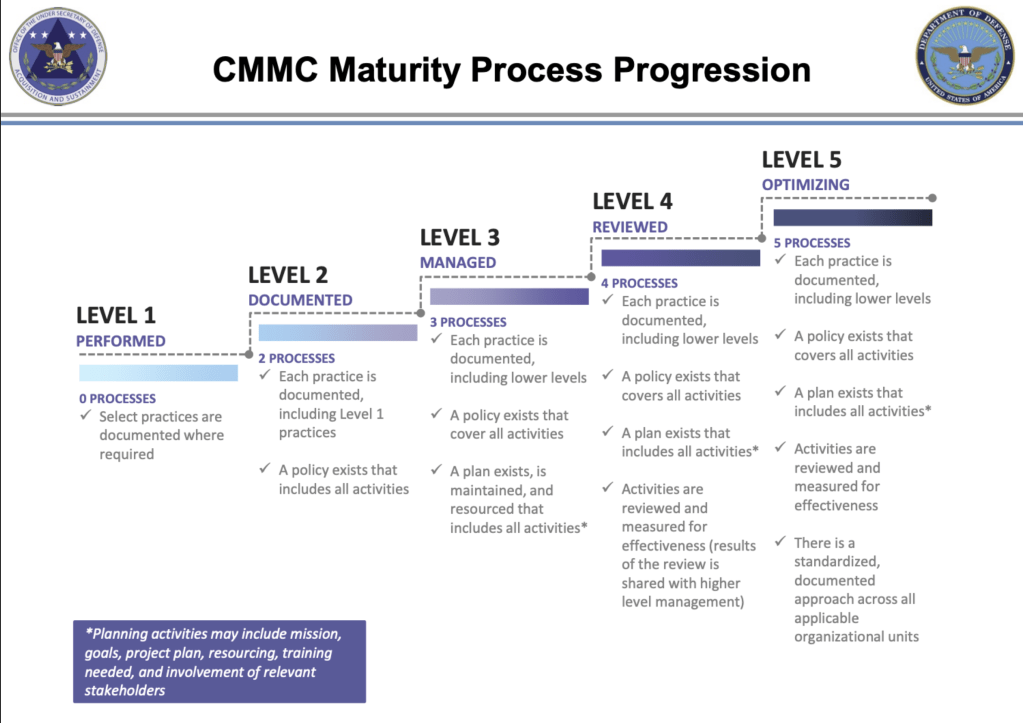
Maturity assessments are that tool. Mapped to a known framework, you can reliably judge your security program, and apply efforts towards domains that are measurably lacking. The most well known maturity model is probably the DoD’s Cybersecurity Maturity Model Certification (CMMC).

CMMC Maturity Levels

This model provides teams with a view on how well prepared they are for a security event. If done regularly, if can provide teams with the satisfaction of showing visible growth across the different domains. Those domains are outlined here:

CMMC Assessment Domains:

  • Access Controls (AC) – Limiting user access to information systems
  • Asset Management (AM) – Documentation of known equipment and approved assets
  • Audit & Accountability (AU) – Ability to track user actions to the individual
  • Awareness and Training (AT) – Measures taken to educate your workforce
  • Configuration Management (CM) – Appropriate configuration, limitation, and use of documented systems
  • ID & Authentication – (IA) – Identifying end users correctly and their ability to access systems (multifactor authentication at CMMC Level III)
  • Incident Response (IR) – Cybersecurity breach and organizational disaster recovery and business continuity planning
  • Maintenance (MA) – Performance of regular maintenance and software updates
  • Media Protection (MA) – Proper disposal, transfer, and housing of FCI and CUI data
  • Personnel Security (PS) – Screening and authorizing users before accessing data, prevention of data loss through employees
  • Physical Protection (PE) – Limiting physical access to resources and monitoring building activity
  • Recovery (RE) – Data backup and recovery strategies, maintaining data integrity
  • Risk Management (RM) – Identifying and mitigating environmental vulnerabilities
  • Security Assessment (CA) – Develop, document, and continually improving security postures
  • Situation Awareness (SA) –  Metric of adapting to latest security exploits and threat mitigation
  • Systems and Communications Protections (SC) – Defining and controlling environment security boundaries, and monitoring for appropriate usage
  • System and Information Integrity (SI) – System updates, identifying malicious content, employing monitoring systems to maintain integrity, protecting e-mail communications

How does an assessment work?

We here Druid Security believe that adopting frameworks like the CMMC, NIST Cybersecurity Framework, or ISO 27001 can help teams develop their capabilities into fully mature programs. During an assessment we work closely with your Security, IT, and other teams in order to conduct in depth interviews and collect detailed evidence. These interviews are confidential, and done with the idea of assisting the organization to level up their capability.

Once the evidence collection is complete, you will receive a comprehensive assessment package, including white papers, recommendations, and tooling guides. Like a good post mortem, the goal of this exercise is to not only recognize gaps and problem areas, but also highlight mature people, processes, and technology that you have already invested in.

To close, if you are looking to start measuring your programs, give us a call. We are here to help!